
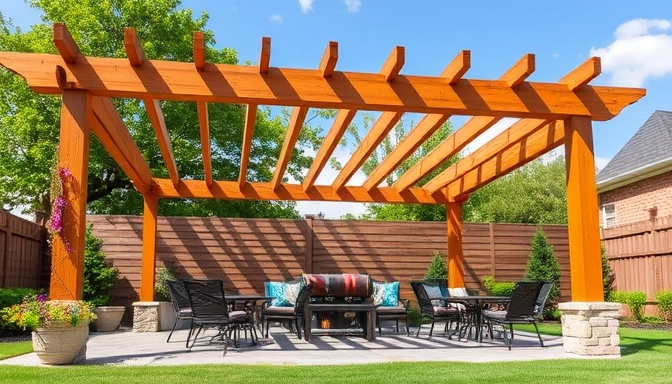

Choosing the right pergola size can make the difference between an outdoor space that feels comfortable and one that feels either cramped or unnecessarily oversized.
A pergola should provide enough coverage for the way you plan to use your patio while still leaving room to move around it. A dining table, outdoor sofa, barbecue, and full outdoor kitchen all require very different amounts of space.
That’s why choosing a pergola based only on what “looks big enough” can lead to problems.
In this https://pergolacave.com/, we’ll explain how to measure your patio, how much space you need for different backyard layouts, and how to compare popular pergola sizes before buying.
What Size Pergola Do I Need?
The right pergola size depends primarily on three things:
- The amount of usable space available
- What you plan to put underneath the pergola
- How much shade and overhead coverage you want
Start with function rather than dimensions.
Ask yourself what you actually want to do underneath your pergola.
Will it cover a small conversation area? A dining table for six? An outdoor kitchen? A combination of dining and lounge furniture?
Once you know the purpose of the space, choosing the correct dimensions becomes much easier.
How to Measure for a Pergola
Before shopping for an outdoor pergola, measure the area where you plan to install it.
Use a tape measure to determine the available width and length. Don’t measure only the patio itself. Look at everything surrounding the proposed installation area.
Pay attention to:
- Exterior walls
- Doors and windows
- Roof overhangs
- Gutters and downspouts
- Existing posts
- Pool edges
- Fences
- Landscaping
- Trees
- Walkways
- Outdoor kitchens
- Utility equipment
- Property boundaries
You should also consider where people will enter and exit the covered area.
A pergola that technically fits within your patio dimensions can still feel too large if its posts interfere with doors or major walking paths.
Don’t Choose a Pergola Based Only on Patio Size
Suppose you have a 15-foot-wide patio.
That doesn’t automatically mean you should install a pergola that covers nearly all 15 feet.
You may want space around the structure for plants, pathways, furniture movement, access to the house, or other backyard features.
Think about the pergola as one part of the entire outdoor environment.
A properly sized louvered pergola should make the patio more functional without overwhelming the rest of your backyard.
10′ x 6.5′ Pergola: Best for Compact Spaces
A pergola around 10′ x 6.5′ can work well for smaller patios and focused seating areas.
This size may be appropriate for:
- A small conversation area
- Two lounge chairs
- A compact outdoor sofa
- A café-style table
- A small patio
- Townhomes
- Side yards
- Poolside seating
The biggest advantage is that you can create a defined shaded area without dedicating a large portion of the backyard to the structure.
A compact 10′ x 6.5′ pergola can also be a good option when you want adjustable shade but need to work around existing landscaping or architectural features.
Before purchasing, measure your furniture rather than assuming everything will fit comfortably.
10′ x 10′ Pergola: A Versatile Backyard Size
A 10′ x 10′ pergola is a popular option because its square footprint works with many common patio layouts.
At approximately 100 square feet of coverage, it can be large enough for a dedicated outdoor living area without dominating many residential backyards.
Depending on your furniture dimensions and required clearance, a 10′ x 10′ pergola may work well for:
- Outdoor dining
- A four-person dining table
- Lounge seating
- A small sectional
- Poolside furniture
- A barbecue and seating combination
- A compact entertainment area
For homeowners who aren’t sure where to start, 10′ x 10′ provides a useful reference point when comparing larger and smaller structures.
10′ x 13′ Pergola: More Room for Entertaining
Moving up to a 10′ x 13′ pergola provides additional room without dramatically increasing the footprint.
Those extra feet can make a noticeable difference when arranging furniture.
A 10′ x 13′ configuration can work well for a larger dining table, a more substantial conversation area, or homeowners who want additional circulation space around their furniture.
It can also work well for rectangular patios where a square pergola wouldn’t make the best use of the available space.
When comparing 10′ x 10′ and 10′ x 13′, lay out the proposed dimensions on the ground before deciding.
13′ x 13′ Pergola: Ideal for Larger Outdoor Living Areas
A 13′ x 13′ pergola creates approximately 169 square feet of covered space.
That additional area gives you much more flexibility when designing a complete outdoor room.
Depending on furniture dimensions, the space may accommodate:
- Larger dining tables
- Sectional seating
- Multiple chairs
- Coffee tables
- Outdoor televisions
- Fire tables
- Barbecue areas
- Combination seating arrangements
This size can be particularly attractive for homeowners who regularly entertain friends and family.
The larger footprint also makes it important to consider how the structure relates to the house and surrounding landscape.
13′ x 16′ Pergola: Great for Dining and Lounging
If you want your pergola to cover more than one activity zone, a 13′ x 16′ pergola gives you significantly more flexibility.
For example, one side could contain an outdoor dining table while the other provides lounge seating.
This can create the feeling of a true outdoor room rather than simply a shaded area.
A larger pergola can also make sense over an outdoor kitchen, where you need room for appliances, counters, seating, and safe circulation.
Before choosing this size, consider how the posts will interact with your patio and whether there is enough surrounding space for the structure to feel proportional to the backyard.
13′ x 19′ Pergola: Designed for Large Entertainment Areas
A 13′ x 19′ pergola can provide more than 240 square feet of coverage, making it better suited to larger patios and entertainment areas.
This size may work for homeowners who want to combine several outdoor functions underneath one structure.
For example:
- Outdoor kitchen
- Dining table
- Lounge seating
- Television area
- Bar seating
- Poolside entertainment
A large pergola can become one of the primary architectural features of the backyard.
Because of that, placement becomes especially important.
You don’t want a large structure blocking important views, interfering with doors and windows, or making the remaining yard feel crowded.
What Size Pergola Is Best for a Dining Table?
Start with the dimensions of your table and chairs.
Remember that the chairs need space to move backward when someone sits down or gets up.
You also need room for people to comfortably walk behind occupied chairs.
Don’t choose a pergola that barely fits the furniture.
For example, if your table and chairs occupy most of a 10-foot width when people are seated, moving up to a larger pergola may create a much more comfortable dining experience.
The goal is to create usable space, not simply fit furniture underneath a roof.
What Size Pergola Is Best for an Outdoor Kitchen?
An outdoor kitchen generally requires more space than a simple seating area.
In addition to counters and appliances, you’ll need room for people to cook and move safely.
Consider the placement of:
- Grill
- Refrigerator
- Sink
- Countertops
- Cabinets
- Bar seating
- Dining furniture
- Walkways
You’ll also need to consider appropriate clearances and manufacturer requirements for cooking equipment.
A larger aluminum pergola may allow you to combine an outdoor kitchen with dining or seating areas under one adjustable roof.
How Much Space Should You Leave Around a Pergola?
There isn’t a universal clearance that works for every backyard.
Instead, consider how people will move around the structure.
You generally don’t want pergola posts positioned directly in the middle of important walking paths.
Leave practical access to doors, gates, pools, outdoor kitchens, and other frequently used areas.
You should also account for local building requirements, setbacks, utilities, and property boundaries.
Depending on the size and location of your project, permits or other approvals may be required.
Always verify local requirements before installation.
Attached vs. Freestanding Pergola Size
Pergola placement can also influence the size you choose.
A freestanding pergola can be positioned independently in the backyard, giving you more flexibility when choosing its dimensions and orientation.
Homeowners may place freestanding structures over:
- Pool decks
- Detached patios
- Outdoor kitchens
- Garden seating areas
- Entertainment spaces
A pergola positioned directly beside a home requires additional attention to doors, windows, rooflines, gutters, drainage, and other architectural features.
The best dimensions aren’t necessarily the same for both situations.
Does Pergola Orientation Matter?
Yes.
Size isn’t the only factor affecting shade.
The direction your pergola faces and the path of the sun across your property can influence how much coverage you receive throughout the day.
Morning and afternoon sunlight can enter from different angles, even when the pergola roof is directly overhead.
This is one reason adjustable louvered pergolas can be particularly useful.
Instead of relying on a fixed roof position, you can adjust the angle of the louvers as sunlight conditions change.
For areas affected by strong low-angle sunlight, compatible side screens may provide additional shade.
Manual or Motorized Pergola?
Once you’ve selected the right size, you’ll need to decide how you want to control the louvers.
A manual louvered pergola uses a hand-operated mechanism to adjust the roof.
A motorized louvered pergola uses an electric motor, allowing you to adjust compatible systems using controls such as a remote or switch.
Manual systems can be attractive for homeowners looking for straightforward operation and value.
Motorized systems can make more sense when you expect to adjust the louvers frequently or want additional convenience.
Our manual vs. motorized louvered pergola guide explains the differences in greater detail.
Does a Larger Pergola Cost More?
Generally, yes.
Larger pergolas require more structural material and additional roof coverage, which typically increases the purchase price.
Installation costs may also increase depending on size and complexity.
Motorization, lighting, screens, electrical work, and other accessories can further affect the total investment.
Before choosing the largest available structure, consider whether you’ll actually use the additional covered area.
If you’re considering an automated system, reviewing how much a motorized pergola costs can help you build a more realistic project budget.
Should You Choose a Standard or Custom Pergola Size?
Standard pergola sizes can be a practical option for many residential patios.
They make it easier to compare products and can eliminate the additional complexity associated with designing a completely custom structure.
Custom sizing may be worthwhile when:
- Your patio has unusual dimensions
- You’re covering a very large area
- Existing architecture limits placement
- The project has specific design requirements
- You’re working with a commercial property
Before moving immediately to custom construction, see whether a ready-to-ship pergola in a standard size fits your space.
You may find that a standard configuration provides the coverage you need without unnecessary customization.
How to Visualize Pergola Size Before Buying
One of the easiest ways to understand pergola dimensions is to mark the footprint in your backyard.
Use painter’s tape, chalk, stakes, or another temporary marker to outline the proposed dimensions.
Then place your existing furniture inside the outline.
Walk around it.
Pull the dining chairs out.
Open nearby doors.
Walk between the house and pergola.
Stand where the posts will be located.
This simple exercise can reveal problems that aren’t obvious when looking at dimensions on a website.
If a 10′ x 10′ footprint feels crowded, compare it with 10′ x 13′. If 13′ x 19′ overwhelms the patio, consider moving down a size.
Common Pergola Sizing Mistakes
One of the most common mistakes is choosing based only on the exterior dimensions of the structure.
Homeowners should also consider the actual usable area beneath the pergola, post placement, furniture dimensions, and required circulation space.
Other mistakes include:
- Forgetting to measure furniture
- Ignoring door clearance
- Blocking walkways
- Choosing too small for dining chairs
- Choosing too large for the property
- Ignoring sun direction
- Forgetting about drainage
- Not checking local requirements
- Failing to consider future furniture or outdoor features
Taking accurate measurements before purchasing can prevent many of these issues.
Which Pergola Size Is Right for Your Backyard?
There is no single best pergola size.
The right choice depends on your backyard, furniture, lifestyle, and how you plan to use the covered space.
For compact seating areas, a 10′ x 6.5′ pergola may provide plenty of coverage.
A 10′ x 10′ or 10′ x 13′ configuration can work well for many residential patios.
Larger 13′ x 13′, 13′ x 16′, and 13′ x 19′ pergolas provide more flexibility for outdoor kitchens, larger dining areas, and entertainment spaces.
The key is choosing based on actual use rather than simply buying the largest pergola that fits.
Find the Right Pergola for Your Outdoor Space
A pergola should feel like it belongs in your backyard.
Before buying, measure the installation area carefully, identify what you want underneath the structure, and leave enough space for people to move comfortably.
Pergola Cave offers manual and motorized aluminum louvered pergolas in multiple sizes for different patios and outdoor living spaces.
Whether you’re creating a compact seating area or a complete backyard entertainment space, choosing the correct dimensions is one of the most important decisions you’ll make.
Measure first, plan the furniture layout, consider the sun, and then choose the pergola that fits the way you actually want to use your backyard.